

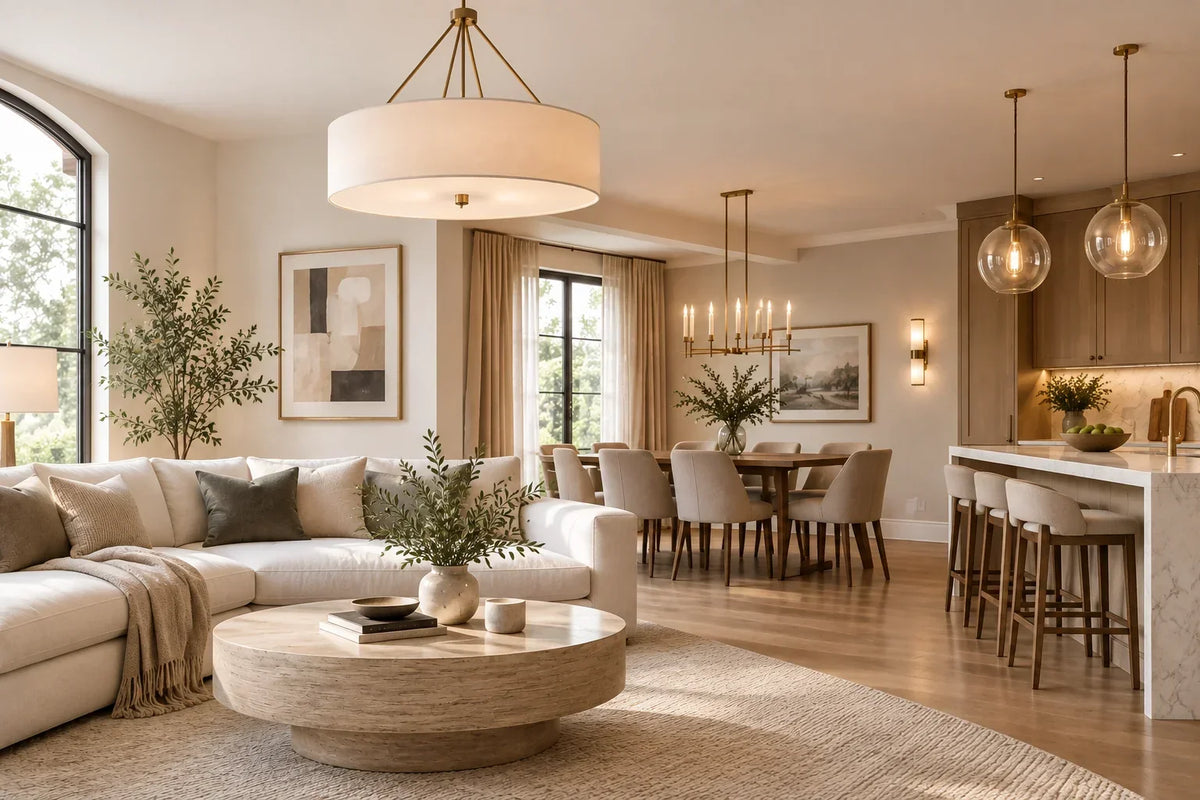
A new 18-watt LED panel goes up in the lounge, someone flips the switch, and the room suddenly feels like a clinic waiting area. Nothing is wrong with the light. It was simply chosen on the wrong numbers.
Learning how to choose LED lights comes down to a handful of specs printed on almost every box: lumens, color temperature, CRI, beam angle and IP rating. Get them right and a room feels warm where it should, bright where you work and easy on the eyes. Get them wrong and even expensive fixtures look cheap.
The case for switching to LED is already settled. The U.S. Department of Energy reports that home LEDs, especially ENERGY STAR-rated ones, use at least 75 percent less energy than incandescent bulbs and can last up to 25 times longer. The real question is which LED, and that is what this guide answers. We start with the specs, then apply them room by room so you can shop with a clear checklist.
Stop Buying by Watts: Lumens Tell You Brightness
Watts measure how much electricity a light draws, not how bright it is. With old incandescent bulbs the two moved together, so "60 watts" became everyday shorthand for brightness. LEDs broke that link, because a 9W LED can match a 60W bulb.
Brightness is measured in lumens (lm). Use this conversion when replacing older bulbs:
| Old incandescent bulb | Brightness | LED equivalent |
|---|---|---|
| 40W | about 450 lumens | 5–6W |
| 60W | about 800 lumens | 8–10W |
| 75W | about 1,100 lumens | 11–13W |
| 100W | about 1,600 lumens | 14–17W |
A good-quality LED produces roughly 80 to 110 lumens per watt. If a product's lumen figure divided by its wattage comes out well below 80, the chip or driver is inefficient.
How many lumens does your room need?
Lighting designers plan in lux, which is simply lumens per square meter. The formula is easy:
Room area (m²) × target lux = total lumens needed
Take a 12 × 14 ft bedroom. That is 168 sq ft, or about 15.6 m². At a comfortable 150 lux, you need roughly 2,340 lumens in total, which three 800-lumen LEDs or four 600-lumen downlights will cover.
Add 20 to 30 percent if the walls are dark, the ceiling is higher than about 10 feet, or the fixtures use frosted diffusers that absorb some light. Target lux values for each room are in the cheat sheet further down.
Color Temperature: Warm White, Natural White or Cool Daylight
Color temperature describes how warm or cool white light looks, measured in Kelvin (K). Lower numbers glow yellow and cozy, while higher numbers look crisp and blue-white.
| Kelvin | Name | How it feels | Best for |
|---|---|---|---|
| 2700–3000K | Warm white | Relaxed, inviting | Bedrooms, living rooms, dining |
| 3500–4000K | Natural white | Clean, balanced | Kitchens, bathrooms, home offices |
| 5000–6500K | Cool daylight | Sharp, alert | Garages, workshops, security lighting |
Two rules save most homes. First, keep one color temperature per room, because a 3000K chandelier next to 6500K downlights looks patchy and unplanned. Second, if you can't decide, choose CCT-switchable fixtures that let you toggle between warm, natural and cool light from the wall switch.
CRI: The Spec Most Buyers Ignore
The Color Rendering Index (CRI) scores how accurately a light shows real colors on a scale up to 100, with natural daylight as the reference. Low-CRI light makes skin look grey, food look dull and wooden furniture look flat, even when the room is bright enough.
Treat CRI 80 as the minimum for any indoor light. Go for CRI 90 or higher in kitchens, dressing areas, makeup mirrors, dining rooms and anywhere you display art or products. If a box doesn't state CRI at all, assume it is low.
Layer Your Lighting: Ambient, Task and Accent
A single ceiling light in the middle of a room creates flat light and dark corners. Professional lighting plans use three layers that work together:
- Ambient lighting provides overall illumination, usually from downlights, panel lights, ceiling fixtures or a chandelier.
- Task lighting focuses on where you work, such as under-cabinet strips in the kitchen, a desk lamp or a vanity light at the mirror.
- Accent lighting adds depth and mood through LED strip lights in false-ceiling coves, wall washers, or spotlights aimed at art and textured walls.
Put each layer on its own switch or dimmer. That single decision lets one room shift from bright and practical to calm and cinematic in seconds.
Room-by-Room LED Lighting Guide
Here is a quick-reference cheat sheet, followed by practical advice for each space.
| Room | Target light level | Color temperature | Minimum CRI | Key tip |
|---|---|---|---|---|
| Living room | 150–300 lux | 2700–3000K | 80+ | Layer and dim |
| Bedroom | 100–200 lux | 2700K | 80+ | No glare above the bed |
| Kitchen | 300 lux general, 500 on worktops | 4000K | 90+ | Under-cabinet strips |
| Bathroom | 200–300 lux, 500 at mirror | 3000–4000K | 90+ | IP44+ near basin, IP65 in shower |
| Home office | 300–500 lux at desk | 4000K | 80+ | UGR below 19 |
| Dining room | 150–300 lux | 2700–3000K | 90+ | Pendant 75–90 cm above table |
| Outdoor | Varies | 2700–3000K décor, 4000K+ security | 70+ | IP65 minimum |
Living room
Aim for warm 2700–3000K light built in layers. Recessed downlights or a slim panel handle ambient light, a cove LED strip in the false ceiling adds a soft glow, and a chandelier or pendant gives the room its focal point. Add a floor lamp beside the sofa for reading, and use dimmers so evenings don't feel like office hours.
Bedroom
Warm 2700K light and dimming are the two essentials. Avoid placing downlights directly above the pillows, where they shine straight into your eyes when you lie down. Bedside wall lights or table lamps handle reading, and a warm, low-level evening setting makes the room feel restful.
Kitchen
Kitchens need natural 4000K light with CRI 90+ so food looks true to color. Overhead lights alone cast your own shadow onto the countertop, so under-cabinet LED strips are the single biggest upgrade, bringing worktops up to around 500 lux. Choose fixtures with smooth surfaces that wipe clean of grease easily.
Bathroom
Choose 3000–4000K and check the IP rating, which shows protection against solids (first digit) and water (second digit). Use IP44 or higher near the basin, where splashes happen, and IP65 inside or directly above the shower. At the mirror, light from both sides or from the front at face height prevents harsh shadows under the eyes.
Home office and study
Natural 4000K light at 300–500 lux keeps you alert without strain. For ceiling panels, look for a UGR below 19 (Unified Glare Rating), the benchmark commonly used for office lighting. Position lights to the side of your screen rather than directly behind or in front of it to avoid reflections.
Outdoor, garden and facade
Every exposed outdoor light should be at least IP65, and in-ground uplights that may sit in rainwater need IP67. Warm 2700–3000K makes facades, gardens and boundary walls look elegant, while 4000K or cooler suits security floodlights. Motion sensors and dusk-to-dawn photocells cut running costs with no extra effort.
Beam Angle, Dimming and Flicker: The Advanced Checks
These are the specs that separate a good lighting plan from a great one.
Beam angle. Narrow beams of 15–30° create dramatic spotlights for art and feature walls. Medium beams of 36–60° suit most downlights, while wide beams of 90–120° spread even light from panels and ceiling fixtures.
Dimming compatibility. Not every LED is dimmable, and a dimmable LED only works smoothly with a matching dimmer type such as TRIAC, trailing-edge or 0–10V. A mismatch shows up as buzzing, flicker or lights that refuse to dim below half brightness.
Flicker. Cheap drivers can flicker faster than you consciously notice, which can still contribute to eye strain and headaches. Point your phone camera at the light: rolling dark bands on the screen are a warning sign.
Driver quality and voltage range. The driver is the electronics inside the fixture, and it usually fails long before the LED chip does. Where the power supply fluctuates, choose products with a wide input voltage range (such as 85–265V) and surge protection, and treat the warranty length as the manufacturer's confidence in its own driver.
7 Common LED Buying Mistakes to Avoid
- Buying by watts instead of lumens. Two 12W lights from different brands can differ noticeably in brightness.
- Mixing color temperatures in one room, which makes the space look unplanned.
- Ignoring CRI, then wondering why the new kitchen makes food look dull.
- Installing non-IP-rated lights in bathrooms, balconies or outdoors.
- Relying on one ceiling light to do the job of three layers.
- Pairing non-dimmable LEDs with a dimmer switch, which causes flicker and early failure.
- Choosing on price alone, when a weak driver and no warranty cost more over time.
Find the Right LED Lights at Alvetto Lighting
Good lighting isn't about the brightest bulb in the shop. It comes from matching lumens, color temperature, CRI and IP rating to the way each room is actually used, then layering light so every space works by day and feels right at night.
Before your next purchase, measure your room, multiply by the target lux from the cheat sheet, and write down the lumen figure you need. That one number prevents most lighting mistakes before they happen.
Planning a new home, renovation or commercial space? Explore the Alvetto Lighting collection or talk to our team for help choosing the right lights for every room.